

Video games as a medium have been around for decades, and the well of truly new ideas has seemingly all but dried up. To remedy this, modern developers revisit ideas pioneered by their predecessors and push them to their limits. Sokoban released in 1981 and kicked off a subgenre of games that sees players pushing boxes around on a grid to solve puzzles. By adding new mechanics, while staying true to the turn-based foundation, modern iterations carve out their own identities within this historic genre. Order of the Sinking Star is an incredible embodiment of what Sokoban style games can be. This game stands among the ranks of heavy hitters like Patrick’s Parabox and Baba is You.
OotSS’s greatest strength lies in its wide array of mechanics which all interact with one another to make puzzles that are the perfect balance of clever and difficult. The game begins with some constants. There is of course the genre defining grid with stones to push around to solve puzzles, along with the now common rewind feature, allowing players to undo any number of their previous actions. This simple foundation creates the perfect environment for planning and experimentation. The foundation is extremely important as Thekla, Inc. seemed to have had far too many ideas to fit into just one game, so they decided to fit four games into one.
Immediately upon finishing the tutorial, you’re met with a world split into four regions, and you stand at the one point at which they all meet. From that point, you’re free to explore. Mini, self contained, puzzles are dotted all over the vast map amongst puzzles in the overworld. Where most games have players navigate a menu or a very primitive overworld to access the real levels with the gameplay, OotSS never misses an opportunity to throw another puzzle your way. In each area players encounter puzzles blocking your progress, but some resources they need are blocked in cages. It’s up to you to play through the nearby levels to unlock those resources so you can solve the overworld puzzles and discover more of the mysterious world you find yourself in. What makes these puzzles really special isn’t the quantity, however, it’s the wide array of mechanics.
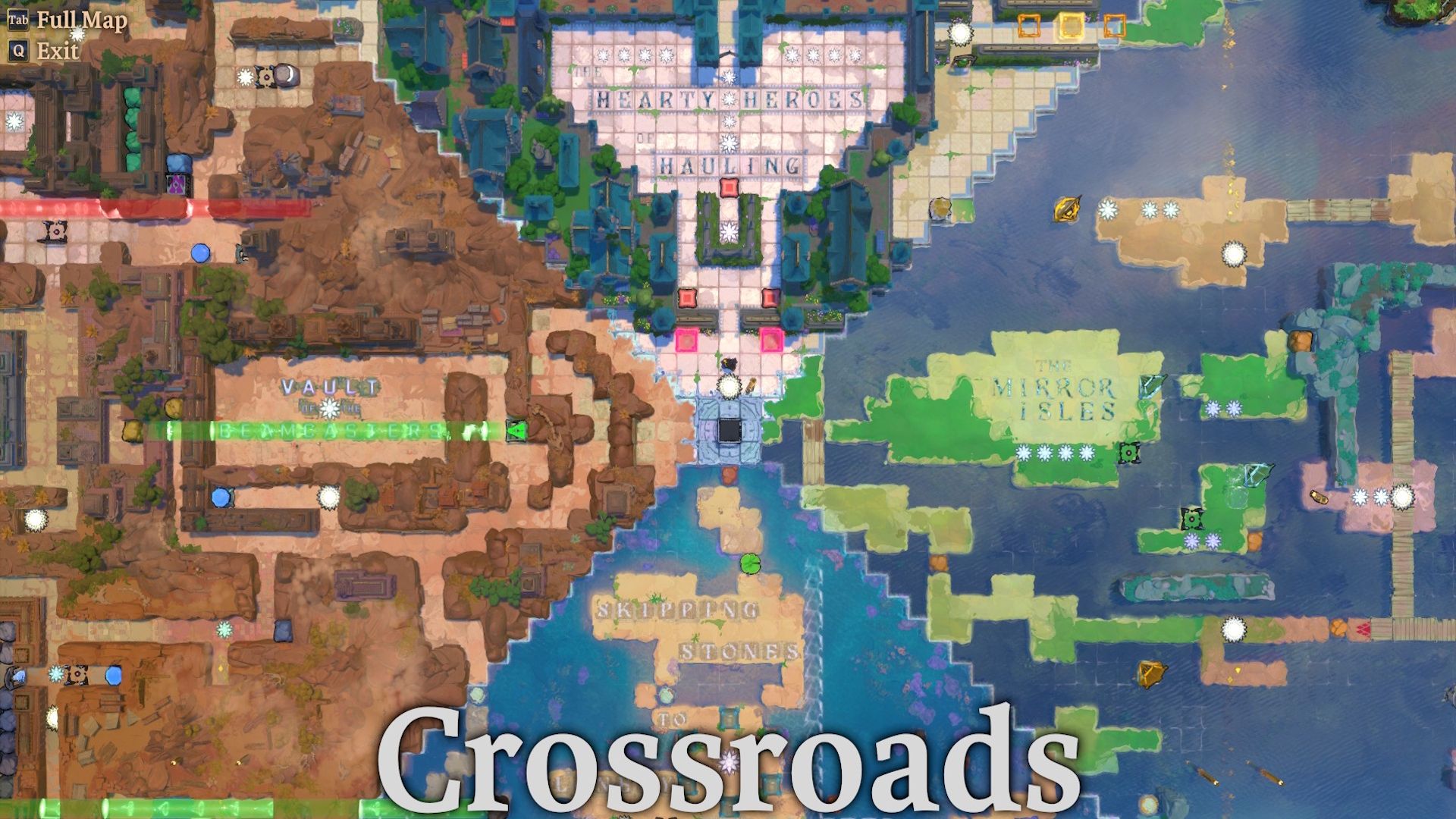
Each of the four regions has its own major mechanic, each of which feels as though it is fully explored throughout the game. The four major mechanics consist of heroes, mirrors, skipping stones, and beamcasters. The heroes each have their own abilities that players can switch between, the mirrors allow objects and players to teleport, the skipping stones can push lily pads to create paths, and the beamcasters give characters in their area of effect special abilities. From the center, puzzles start out simple, teaching you the basics of the mechanics, and the mechanics are fleshed out and expanded upon the deeper you get into each area. This creates a structure in which early levels teach you different ways in which all the mechanics can be used, and later levels put those ideas into practice and build upon them. This culminates in the regions’ mechanics crossing over at their shared borders.
Some of the best levels across the entire game come as a result of these completely separate ideas being merged to make one puzzle. The first of each of these crossovers takes place in a level split down the middle to emphasize the regions and their mechanics crashing together. Coming across a crossover level is very surprising, and the importance of the level is well-represented by the jarring visual of the level being split down the middle. The game increases in complexity and nuance from those levels onward. The introduction to this shift is treated with an appropriate weight that brings players to appreciate the depth that will be achieved in the puzzles to come.
While the gameplay is deepening, the story unravels in front of you. The story is split between the overarching overworld story and the four stories going on in each regions’ respective levels. The most compelling of these stories is the overworld story. In short, you follow a previous explorer who explains some of his discoveries, while slowly unveiling some project going on across the overworld, puzzle worlds, and seemingly some unknown higher plane. The overall story is compelling but its delivery feels overdone and somewhat drawn out. The game uses tapes left behind by your predecessor to deliver its story; to those experienced in story-driven games, this will feel terribly cliche. On top of this, the non linear world structure, and the cerebral nature of the gameplay could make the story a bit of a drag to follow. It could be several hours between the snippets of overworld story so the tapes end up taking a backseat to the gameplay. The quality of the dialogue makes its delivery a real shame.
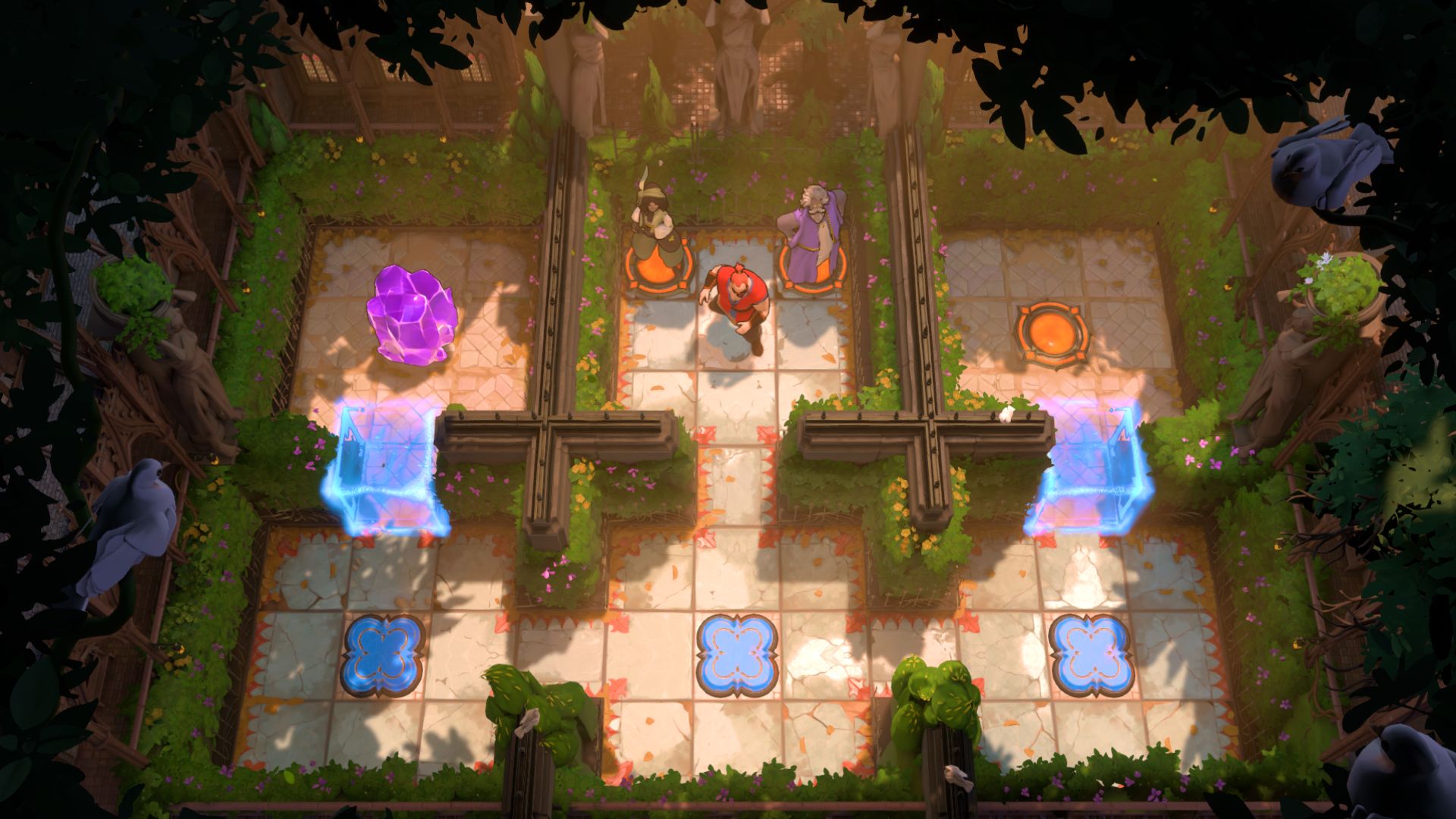
OotSS is fully voiced, and the dialogue between characters is very charming. The heroes’ levels in the North of the map are especially notable for this. The talent of the voice actors along with the high quality script can even make one sided conversations with the completely silent priestess into cute little moments. The casting is very strong, with each voice actor fitting the diverse cast very well. The only thing weakening the script is how often characters are basically talking to themselves. While the commitment to adding dialogue to a lot of the game is commendable, so many of the levels and the entire overworld are populated by solitary characters. This leads to characters either talking to themselves or addressing someone who isn’t there. These monologues feel forced at times which can really break immersion. The immersion breaks are a real disservice to the rest of the world, which is otherwise quite pleasing.
The game has a fairly basic fantasy style for the most part, which is charming and inoffensive. This style is accented by elegant visual effects, and serene music. The overall style and the visual effects work in tandem with a beautiful soundtrack to present a nice looking world, while suggesting that there’s also something deeper. These audiovisual elements are an ingenious reflection of the philosophy taken with the gameplay. Like how the simplicity of the subgenre is a conduit for the more complex, unique mechanics, the simple visual style allows for the VFX and music to really shine.
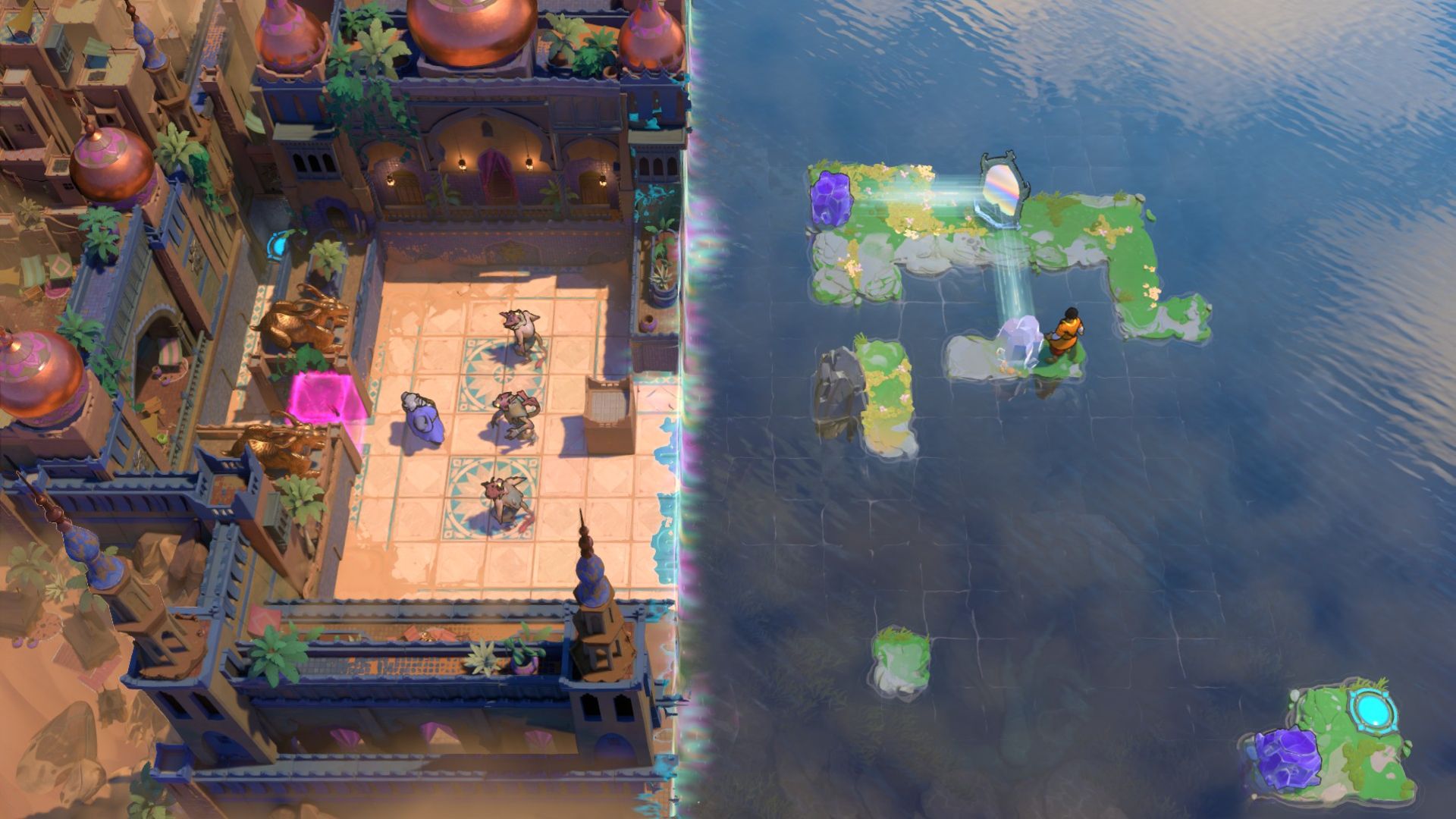
I would be remiss if I didn’t include the moment that OotSS went from good to great in my mind. After playing for several hours I got completely stuck on the first crossover puzzle I found. I left to solve puzzles elsewhere, I took a break from the game, and when I came back I still couldn’t crack it. It wasn’t until I was about to fall asleep that night, I had an epiphany, and I immediately booted up my game to try my new idea. The satisfaction I felt solving that puzzle in the middle of the night was a feeling that is hard to find across the entire medium of games. There were several puzzles that gave me a somewhat similar experience of struggling for so long and feeling like an absolute genius once I found the solution. These experiences are a testament to the fantastic level of challenge and clever design throughout so many puzzles in OotSS. If you’ve played a lot of puzzle games, you’ll find so much to love here, and if you haven’t, this is a great place to start.
Score: 8 out of 10
Reviewed on PC
